Venice Biennale 2026: all the national pavilions, artists and curators
Nabil Nahas’s monumental frieze at Venice reflects the culture of Lebanon, his birth country, not through the lens of war, but through its creativity, history and artistic vitality...more
Nabil Nahas’s installation for the art biennale explores nature, spirituality and his country’s layered cultural history, writes Maghie Ghali. Nabil Nahas has spent more than five decades redefining the boundaries of abstraction. As the Lebanese-American artist prepares to represent Lebanon at the Venice Art Biennale this year, his work for the national pavilion feels like a culmination of the many artistic chapters of his career. Titled Don’t Get Me Wrong, and curated by Nada Ghandour, Nahas’s vision for the Lebanese Pavilion will unfold as an immersive space in Venice’s Arsenale shipyard, exploring the relationship between humanity, nature and the cosmos....
Art Paris runs through Sunday at the Grand Palais (Paris), gathering dozens of international galleries and hundreds of artists under one roof, from established names to emerging voices, from every corner of the world......
Lebanese American artist Nabil Nahas, known for his vivid textured paintings of fractal, geometric patterns incorporating organic elements such as seashells and starfish, has been chosen to represent Lebanon at the Sixty-First Venice Biennale, to take place May 9–November 22, 2026. News of his participation was announced by Dubai-based gallery Lawrie Shabibi. The pavilion is commissioned by the nonprofit Lebanese Visual Art Association, of Paris, and by French curator Nada Ghandour. The commissioners in a statement lauded Nahas for his “intricate relationships between nature, geometry, and the cosmos” in a “visual language that seamlessly blends abstraction and figuration,” while the selection committee praised him for offering a “poetic vision of the world” that “resonates with contemporary concerns while evoking both the spiritual and the material, the intimate and the cosmic.”.....
The Pavilion of Lebanon will present Don't Get Me Wrong, an exhibition by Nabil Nahas and curated by Nada Ghandour, for the 61st Venice Biennale. Located in the Arsenale, the monumental installation spans across forty-five linear meters and is composed of twenty-six acrylic-on-canvas panels.The artist explores the relationship between man, nature, and the cosmos in this immersive work, offering a visual and spiritual experience which transforms the spectacular into a vehicle for introspection.Reflecting Lebanon’s fluid and multicultural identity, the Pavilion celebrates unity in diversity and the beauty of contradictions, in line with the artistic research Nabil Nahas has been pursuing over several decades, travelling between Lebanon and the United States.
Representing Lebanon at the 2026 edition of the Venice Biennale is Beirut-born artist Nabil Nahas, who is having a number of his nature-inspired pieces on view. Although Nahas spent many years of his life and career in the US, his work shows a deep attachment to his roots in his native Lebanon, depicting its famed olive and cedar trees through bold colours and gestures. As seen in this untitled work from 2025, Nahas presents a textured, close-up composition of the cedar tree, using shades of goldish yellow and black, a beloved symbol of Lebanon, representing the notions of resilience and strength. @nabilrnahas
Nabil Nahas has been painting for seven decades. From his childhood in Lebanon to his career in New York, he is now presenting his latest monumental work in Venice as his country’s representative at the 2026 Contemporary Art Biennale. The artist speaks to us about his connection to the ancient civilisations of his homeland, and why he believes politicising international platforms is the wrong approach. We also take a tour of a new exhibition exploring millennia of diverse civilisational influences on Byblos, as the Arab World Institute in Paris shines a spotlight on the Lebanese port city’s rich cultural heritage. #NabilNahas #Lebanon #LaBiennale
Lebanese Pavilion for La Biennale di Venezia 2026 Brings Together History, Heritage and HeartAt the 61st Venice Biennale, Lebanese-American artist Nabil Nahas uses the global stage to offer a fuller, richer view of Lebanon beyond the headlines
For much of its recent history, Lebanon has been defined by conflicts and crises, but this belies a ten thousand year legacy of Greco-Roman, Phoenician, Judeo-Christian, Byzantine and Islamic civilisations, all of which continue to influence contemporary Lebanese society and culture to this day. Even the Bible contains references to Lebanon’s iconic cedar trees, reflecting not only the country’s natural beauty and spiritual resonance, but also the country’s place as a major centre of trade and ideological exchange. The Levant is often called the ‘Cradle of Civilisation’, and yet this cultural wealth is too often forgotten, obscured as it is by the shadows of Lebanon’s modern troubles: political instability, sectarianism, economic collapse, and war. For Lebanese-American artist Nabil Nahas, representing his country at the 61st edition of La Biennale di Venezia is an opportunity to show the rest of the world that there is more to the story of Lebanon than just sorrow and war; an apropos purpose for a piece quietly yet defiantly entitled: ‘Don’t Get Me Wrong’........
Titled Don’t Get Me Wrong, and curated by Nada Ghandour, Nahas’s vision for the Lebanese Pavilion will unfold as an immersive space in Venice's Arsenale shipyard, exploring the relationship between humanity, nature and the cosmos.
The pavilion is an ode to Lebanon’s fluid, multicultural essence, celebrating unity within diversity. It captures the beauty of contradictions – a central theme in Nahas’s decades-long artistic journey between Lebanon and the US, where he is based.TN MagazineManuel Rabate on leaving Louvre Abu Dhabi after a transformative decade
Spanning 45 linear metres within the Arsenale, the installation consists of 26 acrylic-on-canvas panels, with scenography by East Architecture Studio. The monumental paintings will be arranged side by side, creating an enveloping frieze that invites visitors to move through the space. The format echoes the narrative ribbons of paintings and carvings found in Greco-Roman architecture, such as the temples of Baalbek and the Parthenon.
Le pavillon du Liban à la Biennale Arte a dévoilé son projet pour 2026 : “Don’t Get Me Wrong”, une installation immersive de l’artiste Nabil Nahas, sous le commissariat de la curatrice Nada Ghandour. L’annonce a été faite lors d’une conférence de presse tenue à la Bibliothèque nationale du Liban, en présence du ministre de la Culture, Dr Ghassan Salamé.
Placée sous l’égide du ministère de la Culture et organisée par la Lebanese Visual Art Association (LVAA), la participation libanaise se tiendra du 9 mai au 22 novembre 2026. Pour le ministre, cette présence dépasse la seule sélection d’un artiste : elle s’inscrit dans un moment où le Liban cherche à “reconstruire la confiance du monde”, et où les créateurs, par leur puissance d’invention et leur rayonnement, contribuent directement à réaffirmer l’image d’un pays “source inépuisable de créativité, d’innovations et de réalisations”. Dr Ghassan Salamé a également rappelé que cette dynamique s’inscrit dans le prolongement de la stratégie des industries créatives lancée par le ministère pour les cinq prochaines années, saluant au passage l’engagement de la LVAA dans la continuité de la présence libanaise sur la scène internationale.
NNA - During a press conference held at the Lebanese National Library, in the presence of the Minister of Culture, Dr. Ghassan Salamé, the Commissioner and Curator of the Pavilion of Lebanon, Dr. Nada Ghandour, presented "Don’t Get Me Wrong", an immersive installation by Nabil Nahas, who represents Lebanon at the 61st International Art Exhibition – La Biennale di Venezia. The Pavilion of Lebanon at Biennale Arte 2026, held under the auspices of the Ministry of Culture and organized by the Lebanese Visual ArtAssociation (LVAA), will take place from May 9 to November 22, 2026.
Pour l’évènement qui se déroule du 9 mai au 22 novembre 2026 à la cité lagunaire, l’artiste transforme le pavillon national en espace d’expérience : 26 toiles en spirale qui interrogent l’identité, le temps et notre rapport au monde fragmenté.
En 2026, l’artiste libanais Nabil Nahas sera le représentant de son pays natal à la 61e Biennale de Venise. Les commissaires du pavillon, la Lebanese Visual Art Association à Paris et la conservatrice française Nada Ghandour ont salué, dans un communiqué, ....
Nabil Nahas to represent Lebanon at the 61st International Art Exhibition- La Biennale di Venezia in 2026
November 22, 2026. Nabil Nahas, an internationally recognized contemporary artist, will represent Lebanon with Nada Ghandour leading as Commissioner and Curator of the Pavilion. The country’s participation is organized together with the Lebanese Visual Art Association (LVAA).
Born in Beirut in 1949, Nabil Nahas moved to the United States in 1969, was awarded a BFA from Louisiana State University and an MFA from Yale University (1972). He currently lives and works between Beirut and New York...
The artist plans to make his mark on the Lebanese pavilion with an installation that draws from various languages he has created, expressing his honor and sense of "great responsibility" towards his country for this prestigious opportunity, as he exclusively shared with L'Orient-Le Jour.....
The dendritic abstractions of Beirut-born artist Nabil Nahas will take root at the Lebanese Pavilion at next year’s Venice Biennale.
The 75-year-old painter was announced as the representative for his birth country at the international exhibition by his gallery Lawrie
Shabibi in Dubai on Monday.
Pavilion commissioners Lebanese Visual Art Association in Paris and French curator Nada Ghandour praised the artist’s ability to explore ‘intricate relationships between nature, geometry, and the cosmos’ in a ‘visual language that seamlessly blends abstraction and figuration’.
Nahas moved to the United States to study in 1969, and only returned to Lebanon to visit 18 years later in the wake of the Lebanese Civil War. He currently works between Beirut and New York, painting trees that are emblematic of his country.
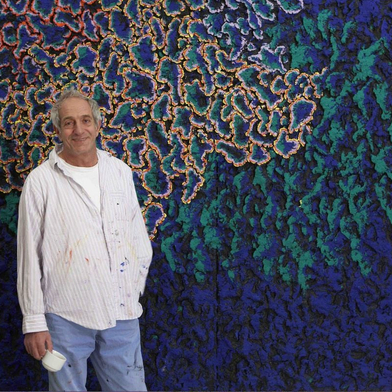
Blending influences from Islamic art and American abstract expressionism, his vivid paintings are known for their textured surfaces and fractal forms, often depicting root or cell-like patterns that spread across the canvas in orderly but organic systems.
The selection committee said he offers a ‘poetic vision of the world’, which ‘resonates with contemporary concerns while evoking both the spiritual and the material, the intimate and the cosmic’.
Nabil Nahas is an artist known for his vibrant, textured paintings that often explore the interplay between nature and abstraction. Born in Beirut in 1949 and educated in the United States, he draws inspiration from both his Middle Eastern heritage and Western modernist traditions. His work frequently incorporates motifs such as fractals, spirals, starfish, trees and organic forms, investigating the relationship between microcosm and macrocosm, as well as cosmography and telluric energy, rendered in thick layers of paint that create a sense of depth and movement. His art reflects a deep engagement with the patterns and structures of the natural world, as well as a nuanced understanding of color and form. His pieces have been exhibited internationally, making him a significant figure in contemporary art. He shares how his Lebanese roots inform his paintings and the origins of his themes of predilection......
Nabil Nahas and the relationship between geometry and nature: a look at the Tethys exhibition at Lawrie Shabibi.
As we immerse ourselves in Nahas's 'Tethys' exhibition at Lawrie Shabibi in Dubai, we are invited to explore the intricate relationship between geometry and nature in his recent works.
Tethys, the solo show by Nabil Nahas at Lawrie Shabibi, sees a retreat into nature in the face of challenging realities.
Bursts of colour and a personal fusion of geometry and nature characterise the oeuvre of Lebanese-American artist, Nabil Nahas, who has returned to Lawrie Shabibi for his solo exhibition, Tethys. Born in 1949 in Beirut, the artist’s youth was divided between Egypt and Lebanon before he left to study in the USA. A graduate of Yale’s Fine Art program, he was a student of American Abstract Expressionist painter, Al Held, whose influence left an imprint on his artistic practice. Situating himself amidst the cultural landscape of 1970s New York, Nahas immersed himself in the artistic milieu of the moment.
The first reaction triggered by the exhibition Les Racines du Giel is that Nabil Nahas (b 1949 in Lebanon) is by no means a painter whose work has developed in a linear way. On the contrary, even after a career spanning over more than 40 years, his practice remains exciting, challenging, unpredictable, at times seemingly contradictory, but ultimately, everything makes sense and falls into place.
The new exhibition by Nabil Nahas at Château La Coste in the south of France gathers together all of the celebrated Lebanese-American artist’s favourite things: starfish, fractals, geometry and the boundless universe.
Words by Y-Jean Mun-Delsalle
Set out across two spaces at the glorious Château La Coste, Nabil Nahas’s exhibition ‘Grounded in the Sky’ simultaneously explores the wonder of nature and the fragility of humankind
The Parisian appartement of Nabil Nahas sits overlooking a lush courtyard a stone’s throw away from the Place de l’Opera. The space, where the artist has lived for just over two years, is filled with a museum worthy collection of Jean Royère furniture. “Things I had in storage” he says, waving around the room at the goat hair covered Baquet armchair. “I didn’t want the space to feel too bourgeois” he adds with a smile when I point out the bare electric wires poking out from behind a light fixture.
Pour sa première exposition personnelle en France, « Les Racines du ciel » présentée par CMS Collection au Château La Coste jusqu’au 13 juin 2023, Nabil Nahas réunit deux facettes essentielles de son travail, ses constellations, leurs références géométriques, et son travail plus intime qui prend racine au Liban. Il fait le choix de présenter ensemble ses séries « Spiral/trees » réunissant là ses inspirations : le végétal, le vivant et les cieux. « La nature, la géométrie, sont le début de tout. Le nombre d’or qui ressort de la façon dont une tige pousse. » Nabil Nahas
Celebrated for his three-dimensional, multi-layered paintings marrying geometry and nature and bursting with vivid color and texture, Lebanese-American artist Nabil Nahas’ first solo exhibition in France, “Grounded in the Sky”, proposes two series of recent works and a never-before-seen outdoor sculpture – his largest to date – evoking a mysterious marine creature. On show until June 13, 2023 at Château La Coste in Provence, the artworks are spread across two gallery spaces of the wine estate: the Renzo Piano Pavilion and the Old Wine Storehouse rehabilitated by Jean-Michel Wilmotte. Large-scale cosmic “Constellation” compositions, referencing both seabed and sky, appear to be pulsating, in perpetual movement, while tortured, apocalyptic depictions of trees emblematic of his homeland – cedars, olives and palms – transform the space into a gallery of botanical portraits, where each appears to lay bare its soul, as viewers are plunged into the artist’s heavy-hearted mental landscape. I sit down with Nahas to discuss his origins and the creative process behind the works in this exhibition.
PARIS: Nabil Nahas, un artiste peintre et sculpteur libano-américain, né en 1949 à Beyrouth et diplômé des beaux-arts à l’université de Yale en 1972, a exposé dans les plus grands musées et galeries à travers le monde, dont Sperone Westwater et Holly Solomon Gallery, à New York; Baumgartner Gallery, à Washington; Milleventi, à Milan; Boston Museum; Lawrie Shabibi, à Dubaï; Saleh Barakat Gallery, à Beyrouth; Ben Brown Fine Arts, à Hong Kong ou encore au British Museum. Il présente ses œuvres pour la première fois en France au Château La Coste, à Aix-en-Provence, du 1er avril au 13 juin 2023.
Nabil Nahas enveloppe le Château La Coste dans sa magie...À la faveur de « Racines du ciel », sa première exposition solo française accueillie au Château La Coste et dont la production a été confiée à CMS Collection, l’artiste américano-libanais déploie les différentes nuances et textures de son œuvre protéiforme, entre ses constellations qui lient l’infime à l’infini, et ses oliviers troublants d’humanité. Il présente également ses sculptures secouées d’une magie qui est la sienne...
New York-based American-Lebanese artist Nabil Nahas grew up in Cairo and Beirut and studied fine arts at Yale University. Over the course of a phenomenal career, the 69-year-old artist has had exhibits at some of New York’s most important galleries, in addition to exhibits in Paris, Beirut and São Paulo, always reinventing himself by exploring new artistic techniques. Throughout the years, his paintings have been abstract, pointillistic or impressionistic, and sometimes a mixture of all three techniques. Most recently, his works have been inspired by Lebanon’s magnificent cedar trees, providing a moving artistic tribute to the country of his birth
Nabil Nahas creates stamp for Lebanon's 75 Years of Independence
New York-based artist Nabil Nahas was born in Beirut in 1949, then spent his formative years between Egypt and Lebanon before leaving for the United States to attend college. Now, Nahas still periodically returns to his birthplace. He started painting at a young age and quickly became interested in abstraction.....
AYK: Why do you think the Americans elected Trump?
NN: This is a very serious political question....
It’s clear that everything that is happening is alarming, to say the least, but I would definitely prefer to educate rather than retaliate.
Nabil Nahas and Alain Kirili (Holly Solomon Gallery, 724 Fifth Avenue, at 57th Street): Looking at Nabil Nahas's new paintings is like walking into a Latin American rain forest
Nabil Nahas is an American painter whose work does not so much “contain multitudes” as it reconciles opposites. Whether implicitly or explicitly, Nahas’s work explores extremes of size, scale, temperature and mood; and seemingly polarized concepts such as nature and artifice, materiality and immateriality
Peintre de la nature et de la géométrie, Nabil Nahas travaille avec un plan précis. Les toiles qu'il livre sont à la fois rigoureuses et luxuriantes. Attaché à rendre compte d'un univers en mutation, il n'en oublie pas moins que le monde est régi par des règles biendéterminées.
It must be hard to give painterliness a new twist these days, but Nabil Nahas’s recent abstract works manage to do so. Literally building up the painterly surface, shaping a mixture of ground pumice and acrylic into what look like organic forms, which he then repaints, the artist gives gesture fresh resonance. His richly textured surfaces, teeming with life and often …
For Lebanese painter, Nabil Nahas, memories of an experience in nature serve as inspiration for his optically-charged paintings of starfish and olive trees. Nahas invited ARTINFO to his New York City studio to preview works for his upcoming exhibit.
Lebanese-American artist Nabil Nahas, whose work has been exhibited all over the world, brings his striking, large-scale works—including a few new pieces—to FIAF’s Gallery.
Nabil Nahas brings his inimitable sense of scale, opulence, and sheer sumptousness back to Dubai this November with a second solo exhibition at Lawrie Shabibi. Focusing this time on his three-dimensional paintings, as tactile as they are optical,
After a particularly heavy storm in 1991, the artist Nabil Nahas took a walk along Southampton Beach in Long Island, New York, and found it littered with starfish, spewed out by the recently tumultuous sea.
Well before the current heightened interest in contemporary art of the Middle East, Nahas had established his reputation in New York art circles as a master of colour, texture and atmosphere.
Nabil Nahas is a delight. We met with him early this year at his studio in Chelsea, overlooking the Hudson, as he was putting the finishing touches on his solo show at Sperone Westwater (on view through May 4 ).
If one person has found his vocation in painting it is unquestionably Nabil Nahas. Not only does he have a communicative love for the medium, but also his work is testimony to his dedication to and joy of exploring painting
Nabil Nahas is perhaps best known for dense, monochromatic acrylic paintings that employ the rigid geometries of Islamic patterning.
We saw your paintings in a solo show in Lawrie Shabibi (Fractals) in November and some of your older work at Art Dubai in March.
Tabitha Piseno interviews painter Nabil Nahas on the occasion of the exhibition of new paintings at Sperone Westwater, New York, on view from April 5 - May 4, 2013.
Born in Beirut in 1949, Nabil Nahas spent the first decade of his life in Cairo before returning to his native country of Lebanon, where he remained until 1968.
In the national-representation section standouts included Willie Doherty's two-screen video installation showing a suited fugitive running in an obscure tunnel that suggests a border zone (Doherty, a Northern Irish artist, was another winning selection, one that called into question the very idea of national representation) and Swiss artist Fabrice Gygi's observation tower with a mechanized elevator. (The theme of panoptic power was rather popular, in fact: On the same floor of the gallery--though not officially in the national-representation section--the Cuban collective Los Carpinteros offered an observation tower made of flimsy tentlike material. On opening night, when the champagne was flowing, I saw a woman ascend the tower's tall ladder only to fall down on her back with a thud, then get up and walk away. The installation is now off-limits.) And Russian artist Alexander Brodsky, listed as an "additional artist," presented a miniature city built inside rusted Dumpsters.
There was also an unusually large number of excellent exhibitors from somewhat less visible countries: Jun Nguyen-Hatsushiba, from Vietnam, who showed jarring videos of men furiously pulling rickshas underwater; Marran Gosov, from Bulgaria, who crammed himself into a small glass box in an endurance act of extreme corporeal discomfort; Lebanon native Nabil Nahas, known for his striking, colorful paintings of amoeba-like shapes; and the lately ubiquitous Anri Sala, from Albania (via France), whose video focused on the interaction of stray dogs and a lion in what looked like an abandoned zoo.
Hug's selection of significant metropolises was criticized in the local art press: New York, London, and Sao Paulo itself were obvious choices, and one can certainly make a case for Tokyo, Beijing, and Berlin as art capitals, but the inclusion of Istanbul, Sydney, Moscow, Caracas, and Johannesburg seemed motivated primarily by an idea of "types" of cultures spread out across the globe--an idea that is challenged by the sometimes violent commingling of cultures one typically finds in the contemporary city. It turns out that Hug had previously worked in Moscow, Caracas, and Johannesburg (as well as Lagos and Brasilia) and was familiar with the art scenes there. This is a forgivable shortcut, to be sure, and it did have the beneficial effect of highlighting what too often goes unnoticed (an active art scene in Caracas, for example), but the choice of these cities too closely limned Hug's rather unoriginal emphasis on economic power centers and biennial havens.
The art in some of these city sections was particularly strong. Berlin was well represented by Frank Thiel and Michael Wesely, both of whom showed large photographs that demonstrate the transformation of (and incipient topographic amnesia in) Germany's capital; the New York section featured Nancy Davenport s barely pre-9/11 terrorist fantasies and Sarah Morris's architecture-inflected paintings; Moscow's group included Boris Mikhailov's big color photographs of lumpen Muscovites; and Sao Paulo broke from the lockstep city-representation mode with Lina Kim's antiseptic white room installation and Vania Mignone's spare, cinematic paintings. But even more impressive was Hug's speculative "twelfth city," in which a dozen artists were asked to respond to "the design of a Utopia." This may have simply been a way to accommodate a spillover of talented artists from certain overrepresented cities and countries, but it worked: Projects ranged from the busy and wryly conceptual (Brazilian architects Isay Weinfeld and M arcio Kogan imagined a thoroughly militarized metropolis complete with armored bateaux mouches, an international bourse, and a refugee park) to the whimsical and elegant (American Sarah Sze's bright corner-hugging sculpture in her usual ready-at-hand materials stretched up several stories of the building, illuminating nuances of Niemeyer's structure). After seeing the work made by these artists, I couldn't help thinking that the idea of the utopian city might have been a more innovative organizing principle for the whole event.
CARTE BLANCHE POUR LE "FRACTAL"....